
Energy yield simulations confirm strong performance of SiLEAN solar technology
The SiLEAN project is developing the next generation of silicon heterojunction (SHJ) solar cell technology — designed to be highly efficient while significantly reducing dependence on critical raw materials. By replacing energy-intensive conventional wafers with epitaxially grown wafers from NexWafe and removing silver and indium from production, SiLEAN aims to contribute to a more resilient, secure, and sustainable PV value chain in Europe.
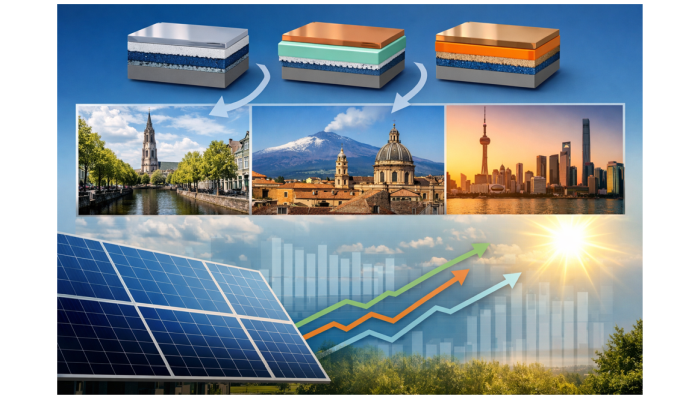
To evaluate real-world performance, partners carried out detailed energy yield simulations for full-size SHJ solar modules in three representative locations: Delft (The Netherlands), Catania (Italy), and Shanghai (China). The work, led by PV Works with support from TU Delft, 3SUN and Forschungszentrum Jülich, compared:
- a state-of-the-art SHJ reference module,
- a Transition Metal Oxide (TMO)–based SHJ module, and
- a Transparent Passivating Contact (TPC)–based SHJ module.
Using validated multi-scale modeling software, the team simulated performance under varying temperature and irradiance conditions, assuming the same wafer thickness (160 μm) and a monofacial 120 half-cut G12 module layout.
The results are encouraging: the TMO- and TPC-based SiLEAN modules achieved higher simulated nominal power (≈595 Wp) compared with the reference module (≈533 Wp). Annual energy yield was also equal or higher across all three climates — demonstrating that the novel architectures can match or outperform today’s industrial SHJ technology while using fewer critical materials.
These energy-yield insights not only confirm the technological promise of the SiLEAN concepts, but also serve as key input for the project’s ongoing life-cycle assessments, helping quantify sustainability gains alongside performance improvements.
Read the full report here.