
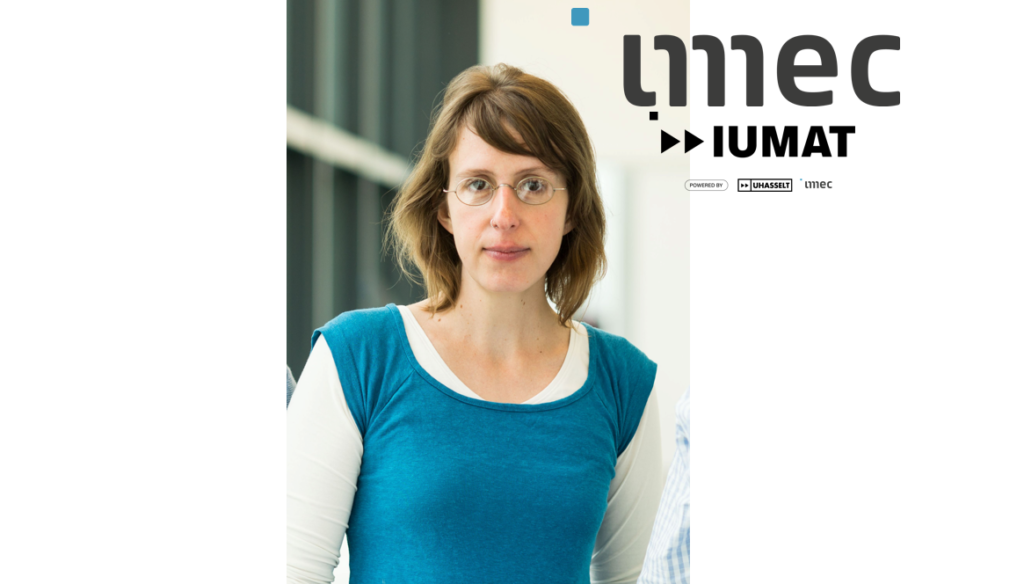
In another dimension, if I were an animal, I am not sure what I would be… But if I were a project, I would probably be SiLEAN! Over my career in PV at imec I have covered, in a bit more than 20 years, (almost?) all of the project’s topics: I started working as a PhD student on kerfless lift-off techniques, shifted to advanced light trapping in thin silicon, and processed ultra-thin heterojunction cells. I am now exploring cell interconnection methods, with keen interest on sustainability, targeting to learn soon about LCA. In the present dimension, being a senior researcher in this project, I am leading WP4 on metallization and interconnection, and coordinating the imec team.
What was your original motivation to become a researcher?
My original motivation was to do… research. As a child, we all go through a phase where we wonder and ask our parents ‘why?’. I guess I have never stopped asking ‘why?’. I have just stopped saying it out loud. Which brought me to study science. I really enjoyed my master thesis, which showed me how research starts with asking ‘why’ and gives the opportunity of searching for a trustworthy answer. What has made me stay in this career so far, is the freedom with which this can be explored.
What is your (main) research area today?
As so many researchers in silicon photovoltaics, my main research topic has drifted a few years ago from cells to modules. Today, I am exploring new ways of interconnecting silicon-based cells (whether single-junction, as in SiLEAN, or multi-junction cells), to enable sustainable photovoltaic electricity production all across the globe. Today I spend most of my time in a supporting role, coordinating and supervising experiments and students. But I try to keep time for being in the lab with my own experiments. I am performing myself some EpiWafer nanotexturing for instance.
What is the main objective of your team in SiLEAN?
Imec has 3 main objectives in SiLEAN, at module, cell and wafer levels. Our largest task is at the module level. We want to achieve a Bi-free interconnection method for SHJ cells, as well as making reliable modules with the new ultra-thin In-free and Ag-free cells. At cell level we want to learn if carbon could be suitable to enable Ag-free contacts for heterojunction cells. Finally, at wafer level, we want to ensure that light can be trapped inside the ultra-thin EpiWafers to keep high device efficiencies despite the strong reduction in absorber material.
What expertise and facilities does your team have to meet those objectives?
We bring two big facilities. In imec-Leuven, we benefit from the largest R&D cleanroom of Europe, where we have built expertise in epitaxial foils, thin wafer handing, texturing, and ultra-clean processing. In Energyville-Genk, the renewable energy research hub of Flanders, we can metallize solar cells, assemble them into modules and extensively test their reliability.
Which aspects of your research at SiLEAN do you believe are the most innovative and what unique opportunities offer SiLEAN to yourself and/or your organisation?
That depends on how one takes the definition of innovative. The “funkiest” is our exploration of carbon pastes in heterojunction solar cells. SiLEAN gives us the opportunity of printing pastes that are tailored for us by a partner, GraphEnergyTech, that fabricates cutting-edge pastes. With this collaboration we will bring new insights on the possibilities and limitations of what graphene pastes may bring for heterojunctions.
But what is most innovative in the sense of bringing new methods to industry, is our multiwire interconnection, TWILL. As a student, I remember I was shocked by the complexity of cell assembly and module fabrication. TWILL makes this process leaner by merging two steps: interconnection and lamination. And what is more exciting, thanks to the other partners: making it compatible with Ag- and In-free solar cells.
That said, if I consider what is beyond imec’s contributions in SiLEAN, I think the deepest innovation comes clearly from EpiWafers. This wafer production that shortcuts the energy-intensive Si value chain has the potential of revolutionizing wafer production and making a big step in reducing the PV environmental footprint.
How do you see the future use of the SiLEAN results and the impact of SiLEAN project in our daily lives?
Personally, and to be honest, the direct application of my work is not what drives me. Serendipity is key in science and technology. I have experienced that findings are not so much about ending where we want, but about staying alert to what the process can reveal.
But if I ask myself ‘why’ (are we doing this): I do know that heterojunction solar cells with lower environmental footprint are essential to the future of PV, that EpiWafers are a fantastic innovation, and that our solar cells will very soon have to be free from critical raw materials. With SiLEAN, we are bringing today knowledge and know-how for that tomorrow.